
USAEDC 2025: Why Agriculture’s Future Depends on Shared Intelligence, Coordinated Strategy, and Predictive Insight
1. A System Under Pressure
The 2025 USAEDC Annual Workshop made one thing unmistakably clear: the global agricultural export system is facing volatility at a speed and scale that no single organization, tool, or program can manage in isolation. Climate variability, supply chain fragility, geopolitical shocks, SPS unpredictability, price swings, and rapidly changing buyer expectations are all converging. Instead of working as separate units, marketers, NGOs, governments, cooperators, and exporters, the industry must operate as an integrated intelligence system. And throughout the conference, it became evident that the gap between when disruptions start forming and when organizations discover them is widening dramatically.
2. The Shift From Reaction to Anticipation
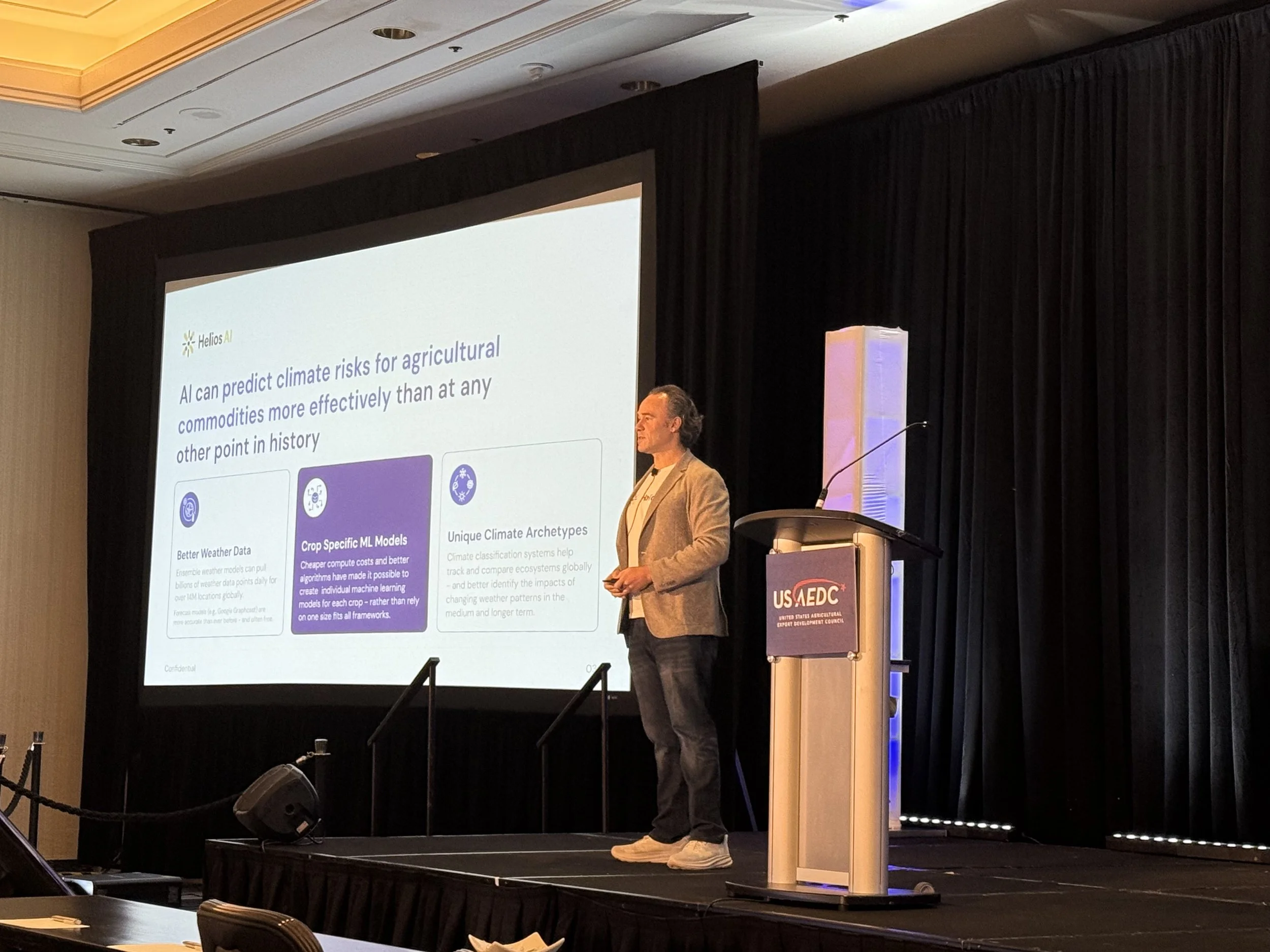
That’s why early-warning capabilities and predictive intelligence became the through-line of so many conversations. As Helios AI’s CEO, Francisco Martin-Rayo, emphasized in his presentation, agriculture is moving from a reactive model into an era where decisions depend on detecting climate, production, and market stress months before they impact contracts, margins, or global supply. Advances in data, compute, and model specificity now allow vertical, domain-built AI systems to process millions of localized climate and commodity signals in minutes. This enables exporters to anticipate shifts rather than scramble after the fact. As he put it:
“We’re not just identifying risk earlier — we’re identifying it early enough to change decisions, not just report on them.”
3. What We Heard Across Sessions
This point was reinforced repeatedly as participants discussed SPS challenges, regulatory inconsistencies, cold-chain limitations, on-the-ground barriers surfaced by NGOs, and fragmented marketing approaches highlighted in sessions like USA Rice’s global messaging discussion. Though each session approached the issue from a different angle, the core frustration was the same: everyone is operating with delayed visibility, and those delays translate into lost tenders, missed signals, supply issues, and fractured global narratives. Many also acknowledged how general-purpose AI solutions, while useful for language tasks, fail to capture commodity-specific, climate-specific, and region-specific dynamics. The distinction between horizontal AI and vertical agricultural AI became particularly evident when examining examples like the banana price–tariff misconception, where domain-specific models accurately traced the real driver: climate-induced supply decline.
4. The Hidden Weakness: Information Gaps
Across trade, logistics, marketing, and development discussions, what became most apparent was how fragile our current information flow is and how often organizations unknowingly duplicate effort or work from incomplete signals. The industry is contending with disruptions that form upstream in the climate system, propagate through production, reveal themselves in supply chains, and finally show up in pricing data far too late to be useful. USAEDC underscored how dangerous this lag has become in an increasingly volatile world.
5. Where Helios AI Fits Into the Future
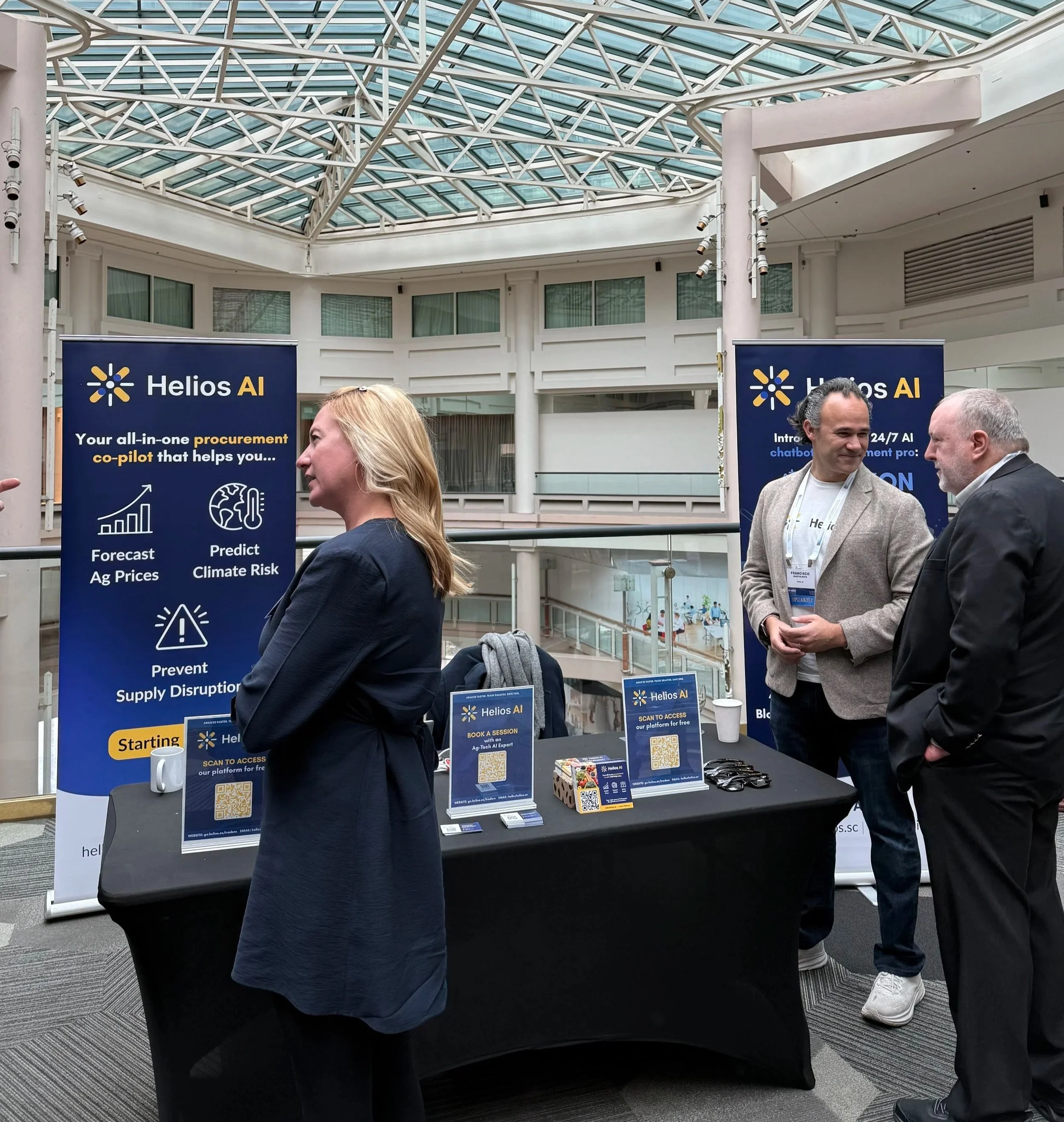
This is exactly where Helios AI fits into the future that the industry is asking for. By integrating climate risk, commodity forecasting, and global disruption detection into one predictive system, Helios gives exporters, cooperators, and supply chain leaders the shared visibility the entire week called for. Vertical, climate-aware AI fills the gaps that traditional models, siloed teams, and horizontal AI tools cannot, allowing organizations to see structural pressure points as they emerge, align messaging and strategy earlier, and protect market share before volatility hits. USAEDC did more than highlight challenges; it validated the need for a unified foresight layer that helps the industry work as one.
6. The Path Forward
In a landscape where risks compound faster than agencies can update datasets or markets can react, the future belongs to systems—and teams—that can anticipate together, not respond alone.
If you or your organization is ready to move from delayed reactions to real foresight, book a demo with Helios AI—and see how climate, commodity, and disruption intelligence can strengthen your supply chain before volatility hits.
